Plate & Filing Types -
We use UHB20C Swedish spring steel for our backsaw plates—a high-quality carbon steel known for its toughness, flexibility, and ability to hold a sharp edge. It takes a precise tooth line, responds well to sharpening, and has the right amount of spring to stay true in the cut without feeling brittle.
Rip Filing
Rip filing is designed for cutting with the grain. The teeth act like a series of small chisels, efficiently removing material as the saw moves forward. This makes rip filing the fastest and most effective choice for breaking down stock along the grain, leaving a slightly rougher surface that can be cleaned up afterward.
Crosscut Filing
Crosscut filing is optimized for cutting across the grain. The teeth are shaped to slice wood fibers cleanly, much like a knife, resulting in a smoother cut with minimal tearout. It’s the preferred choice for joinery and finish cuts where surface quality matters most.
Hybrid Filing
Hybrid filing is a balanced tooth pattern that performs well in both directions. It won’t match the speed of a dedicated rip saw or the finish of a true crosscut, but it handles both tasks effectively. For those who want one saw that can move between ripping and crosscutting without switching tools, hybrid filing offers a versatile, practical solution.
Folded Sawbacks -
Our sawbacks are made the traditional way—folded, not milled. It’s more work, but there’s a reason it’s been done this way for generations.
Each back is formed from cold rolled steel, which gives it the strength and durability needed to hold tension over the long haul. The folded design wraps tight to the plate, adding stiffness while still allowing the saw to move and be tuned over time. It also lets us retension the toothline when needed, helping the saw keep cutting straight and true for years.
Most modern saws use milled, static backs. They’re easier to produce, but once they’re on, they’re on. There’s no real way to adjust them, and they don’t offer the same long-term durability or serviceability.
We offer three coating options for our backs: black oxide, nickel plating, and titanium. Each adds corrosion resistance, with titanium also increasing surface hardness for even greater durability.
We stick with folded backs because they work better—plain and simple. They’re stronger, they last longer, and they let us build a saw you can actually maintain and use for decades.
Handle -
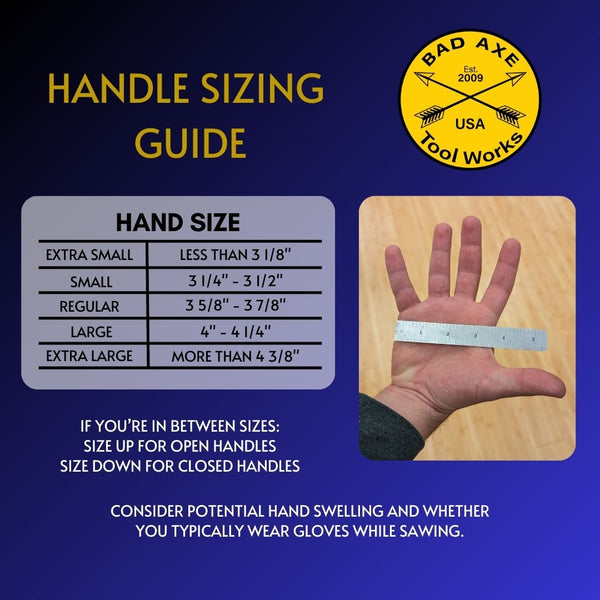
Every Bad Axe handle starts with full-heart, quartersawn hardwood—Cherry, White Oak, Hard Maple, or Walnut.
We use quartersawn stock for a reason. It’s the most stable cut you can get, which means less seasonal movement and a handle that stays true to the plate over time. It costs more, but it holds up better—and that matters in a tool you’re going to use for years.
Each handle is hand-finished with Watco Danish oil—natural on Cherry, Oak, and Maple, and black walnut on our Walnut handles—then polished with Tripoli and buffed out with carnauba wax for a smooth, durable feel in hand.
All of our lumber comes from a long-standing, family-owned supplier that practices responsible harvesting. We’ve worked with them from the beginning, keeping our materials close to home and building our saws with North American hardwoods we trust.
Fasteners -
We offer four fastener options: solid brass (standard), or steel fasteners finished in black oxide, electroless nickel, or niter blue.
Each option brings its own look to the saw. Brass is the traditional choice and develops a natural patina over time. Our steel fasteners offer a more modern feel, with black oxide giving a low-profile matte finish, electroless nickel adding a clean, bright look with strong corrosion resistance, and niter blue bringing a deep, heat-treated color that stands out on the handle.
All of our current saws use a slotted nut design rather than traditional split nuts. This makes them easy to adjust or service using common tools you already have in the shop—no specialty screwdrivers required.